Introduction
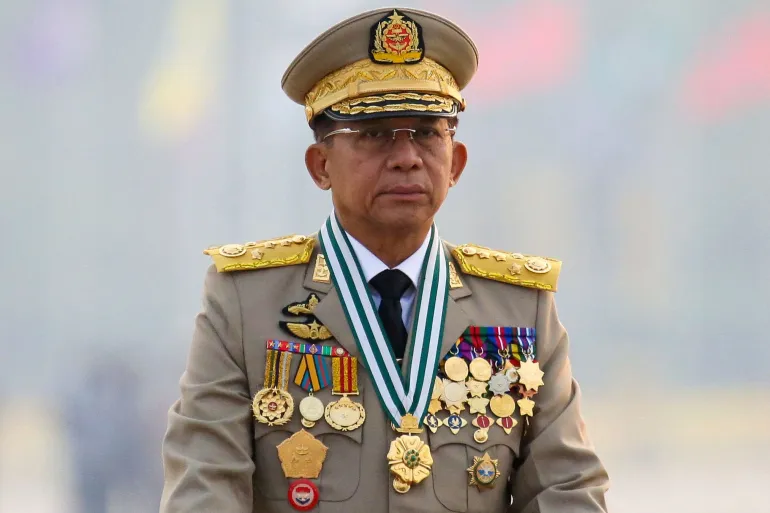
Five years after Myanmar’s democracy was derailed by a military coup, the man behind it—Min Aung Hlaing—is now poised to become the country’s president.
What is being presented as a long-promised return to civilian rule is, in reality, raising serious concerns among analysts, opposition groups, and the international community. Rather than signaling democratic restoration, this transition appears to cement military dominance under a civilian label.
The 2021 Coup That Changed Myanmar
On 1 February 2021, Min Aung Hlaing overthrew the elected government led by Aung San Suu Kyi, alleging election fraud without credible evidence.
Immediate consequences:
- Mass protests erupted across Myanmar
- A nationwide civil disobedience movement began
- Security forces responded with violent crackdowns
Within months, the country descended into a full-scale civil war, with armed resistance groups forming across multiple regions.
At the time, Min Aung Hlaing promised:
Elections within one year and a return to civilian governance.
That promise has now taken five years to materialize—and even now, its authenticity is widely questioned.
The 2026 Election: A Controlled Political Process
The recent election that paved the way for his presidency has been heavily criticized.
Key concerns:
- Major opposition parties were banned or sidelined
- Many candidates linked to democratic forces were arrested or disqualified
- Large parts of the country, affected by conflict, could not vote
The military-backed
Union Solidarity and Development Party (USDP)
secured a dominant victory.
Combined with:
- The military’s constitutionally guaranteed 25% of parliamentary seats
- A fragmented and suppressed opposition
…the outcome was effectively predetermined.
👉 Analysts widely describe the process as “managed democracy” or “electoral authoritarianism.”
A Presidency Without Real Civilian Control
Although Min Aung Hlaing has formally stepped down as commander-in-chief, this move is largely procedural.
Why his power remains intact:
1. Control Over the Military
His close ally,
Ye Win Oo,
has taken over as military chief—ensuring loyalty at the top.
2. Creation of a Powerful Council
A newly established consultative council will:
- Oversee both civilian and military affairs
- Act as a parallel power structure
- Likely remain under Min Aung Hlaing’s influence
3. Military-Dominated Government
Most key positions in the upcoming administration are expected to be filled by:
- Former generals
- Military-aligned technocrats
👉 This ensures that even without a uniform, Min Aung Hlaing remains the central authority.
Civil War Still Ongoing
Myanmar today is far from stable.
Current situation:
- Armed resistance groups control parts of the countryside
- Ethnic armed organizations continue long-standing conflicts
- Urban guerrilla attacks persist
Human cost:
- Thousands killed since 2021
- Millions displaced internally
- Economic collapse affecting everyday life
Despite the election, violence has not stopped, and many groups reject the legitimacy of the new political system.
International Reaction
The global response is expected to be largely critical.
Western countries:
- Likely to reject the election as neither free nor fair
- May impose or expand sanctions
Regional actors (ASEAN, China, India):
- More cautious responses
- Focus on stability over الديمقراطية
Human rights organizations:
- Continue to accuse the military leadership of:
- War crimes
- Crimes against humanity
👉 The presidency is unlikely to improve Myanmar’s global standing.
Why This Move Matters
This transition is significant for several reasons:
1. Legitimacy Strategy
Min Aung Hlaing appears to be:
- Seeking international recognition
- Attempting to normalize military rule
2. Constitutional Manipulation
By following legal procedures (stepping down, elections), the military:
- Creates an illusion of democracy
- Maintains real power behind institutions
3. Long-Term Control
The system being built ensures:
- Military influence regardless of election outcomes
- Limited space for genuine opposition
What Happens Next?
Myanmar’s future remains uncertain.
Possible scenarios:
- Continued civil war with no clear resolution
- Increased repression to maintain control
- Gradual normalization of military-backed governance
For many citizens and observers, this is not a transition—but a rebranding of authoritarian rule.
Conclusion
The rise of Min Aung Hlaing to the presidency marks a pivotal moment in Myanmar’s modern history—but not necessarily a hopeful one.
Five years after overthrowing a democratic government, he now stands ready to lead a “civilian” administration that remains deeply rooted in military power.
The key question remains:
👉 Is this the beginning of stability—or the continuation of conflict under a different name?