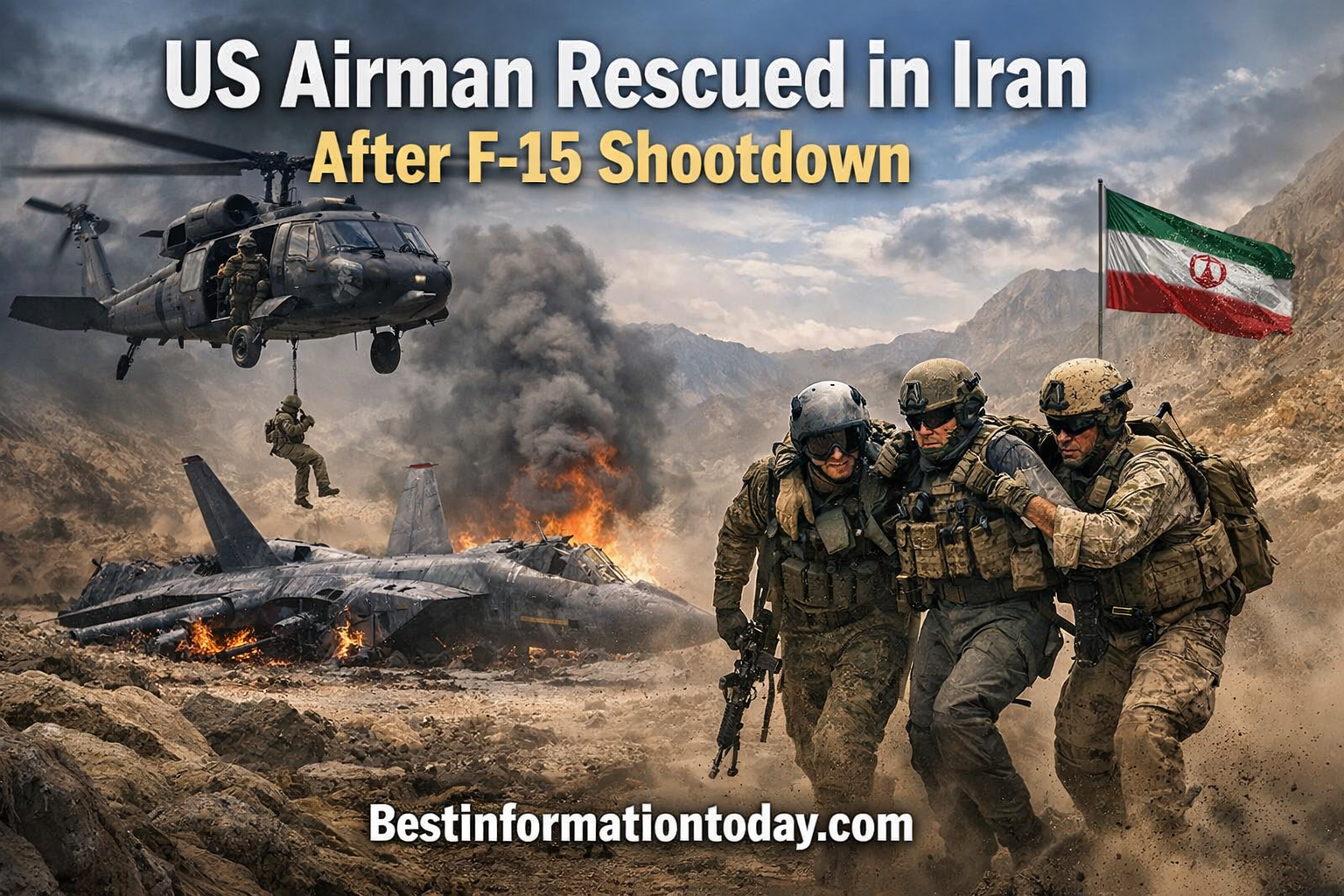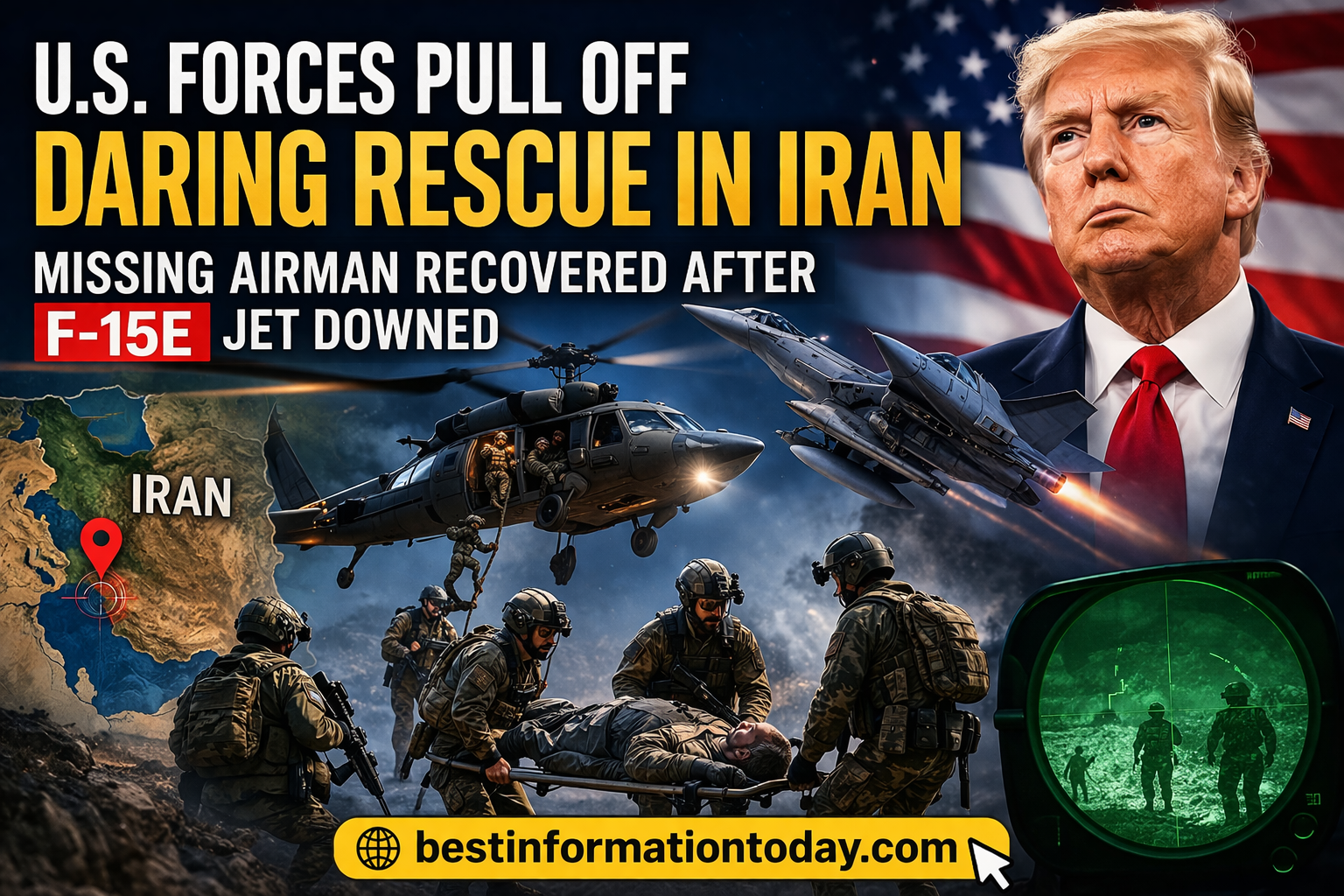
In a dramatic turn of events, President Donald Trump confirmed on April 5, 2026, that U.S. forces successfully rescued a missing airman from Iran after a fighter jet was downed. He described the operation as one of the most daring search-and-rescue missions in U.S. history. The rescue ended a tense standoff and showcased the United States’ ability to operate in hostile environments.
The mission centered on a U.S. F‑15E Strike Eagle, which was struck by Iranian air defenses over southwestern Iran. Both crew members ejected safely, but one remained unaccounted for until the daring operation concluded. U.S. forces executed the mission under extreme conditions, combining precision, speed, and intelligence to ensure success.
The Downing of the F‑15E
On April 3, 2026, the F‑15E was flying a routine patrol mission when Iranian defenses struck it. Both crew members ejected from the aircraft at high altitude. U.S. forces responded immediately, sending reconnaissance drones and helicopters to locate the survivors.
Iranian media reported the downing and published images of the wreckage, claiming responsibility. The Iranian government stated that it had targeted the aircraft as it entered their airspace. U.S. authorities confirmed the aircraft was downed and focused on rescuing both crew members.
One crew member reached safety within hours. The second, a colonel and weapons systems officer, remained in hostile territory for over 48 hours. Officials feared that Iranian military units or local militias might capture him. The prolonged uncertainty heightened tensions in Washington and across U.S. military command centers.
Planning the Daring Rescue
The rescue mission required meticulous planning. U.S. commanders deployed a combination of helicopters, fixed-wing aircraft, and special operations teams deep inside Iran. Surveillance drones and intelligence-gathering assets pinpointed the exact location of the stranded airman.
President Trump described the operation on his Truth Social platform:
“WE GOT HIM! The United States Military pulled off one of the most daring Search and Rescue Operations in history… and our crew member is now SAFE and SOUND!”
Military sources said the airman sustained injuries but remained conscious and responsive during the rescue. The operation unfolded under the threat of hostile fire, harsh terrain, and unpredictable weather conditions. U.S. forces coordinated air support and ground operations in real-time to neutralize threats and secure the airman.
Execution Under Fire
The rescue faced intense combat risks. U.S. aircraft encountered small-arms fire and anti-aircraft threats. A U.S. Black Hawk helicopter sustained minor damage but completed the extraction successfully. An A‑10 Thunderbolt II provided air support and faced enemy fire, but its pilot safely returned to base.
Special operations teams executed a rapid ground insertion to retrieve the airman. Using night vision and advanced surveillance tools, they navigated rugged terrain while avoiding detection by Iranian forces. Intelligence suggested hostile units were nearby, and teams had to act with precision.
Despite the dangers, U.S. forces returned all personnel safely, marking the mission as both a tactical and operational success. Analysts described it as a textbook example of modern combat search-and-rescue operations.
Airman Survival and Resilience
The rescued airman, a colonel and seasoned weapons systems operator, demonstrated remarkable resilience. He navigated hostile terrain while injured and avoided capture until U.S. forces reached him. The military highlighted his training, discipline, and courage as key factors in his survival.
This operation also reflects the extensive preparation U.S. service members undergo for high-risk scenarios. Search-and-rescue teams train for hostile environments, survival skills, and rapid extraction techniques. The successful recovery underscores the effectiveness of these programs.
Strategic Implications
The rescue carries significant strategic weight. Trump highlighted the operation as evidence of U.S. military strength. The successful extraction reassures allies and signals to Iran that U.S. forces can operate decisively, even deep inside hostile territory.
The operation also reduces the immediate political pressure on Washington. High-ranking officers behind enemy lines often compel leaders to act quickly, sometimes escalating conflicts. By rescuing the airman, the U.S. avoided a potential crisis scenario that could have triggered broader military responses.
Iran, meanwhile, has issued warnings against further incursions. Officials emphasized that they will respond to violations of their sovereignty. The tension remains high, but the rescue demonstrates U.S. capabilities without triggering full-scale escalation.
Military Expertise and Technology
The operation relied on advanced technology. Drones provided continuous intelligence, guiding extraction teams to the airman’s location. Satellite imagery confirmed enemy movements, while encrypted communications maintained real-time coordination.
Helicopters and transport aircraft executed precision maneuvers. Special operations teams deployed rapidly, using night vision and stealth tactics to avoid detection. Air support from fighters ensured the extraction zone remained secure.
Experts note that such rescues require seamless integration of air, land, and intelligence assets. The success in Iran underscores the U.S. military’s ability to combine these elements effectively, even in high-risk areas.
Regional and Global Impact
The operation sends a strong message to allies and adversaries alike. It demonstrates U.S. readiness to protect its personnel and conduct missions under extreme conditions.
The rescue also carries diplomatic implications. While tensions with Iran persist, the mission reduces the risk of immediate escalation by safely recovering a high-ranking officer. Allies in the Middle East, Europe, and Asia will likely interpret the mission as evidence of U.S. operational competence and commitment to security.
Public and Political Reaction
President Trump’s announcement drew widespread attention. Officials praised the mission as a display of American military prowess and the bravery of service members. Analysts noted that the rescue strengthens Trump’s position domestically, highlighting decisive leadership in a high-stakes situation.
The U.S. Congress and military leadership issued statements commending the airman and the rescue teams. Many emphasized the importance of maintaining advanced training, robust intelligence, and quick-response capabilities for future operations.
Looking Ahead
The U.S. rescue mission sets a precedent for operations in hostile territory. It highlights the importance of intelligence, rapid planning, and coordinated execution.
While U.S.-Iran tensions remain high, the operation offers a measured success that can influence diplomatic negotiations. The airman’s recovery demonstrates that decisive action can save lives without escalating conflict unnecessarily.
Analysts expect the region to remain volatile. However, the operation showcases the effectiveness of modern combat search-and-rescue missions and the capabilities of American forces to conduct high-risk missions worldwide.