The dramatic rescue of a United States airman deep inside Iranian territory has quickly become one of the most significant and high-risk military operations in recent years. The incident, which began with the downing of a US fighter jet, has unfolded against the backdrop of escalating conflict in the Middle East, involving the United States, Iran, and regional allies. While many details remain unclear, emerging reports provide a compelling picture of a daring mission carried out under extreme conditions.
The Incident: A Fighter Jet Shot Down
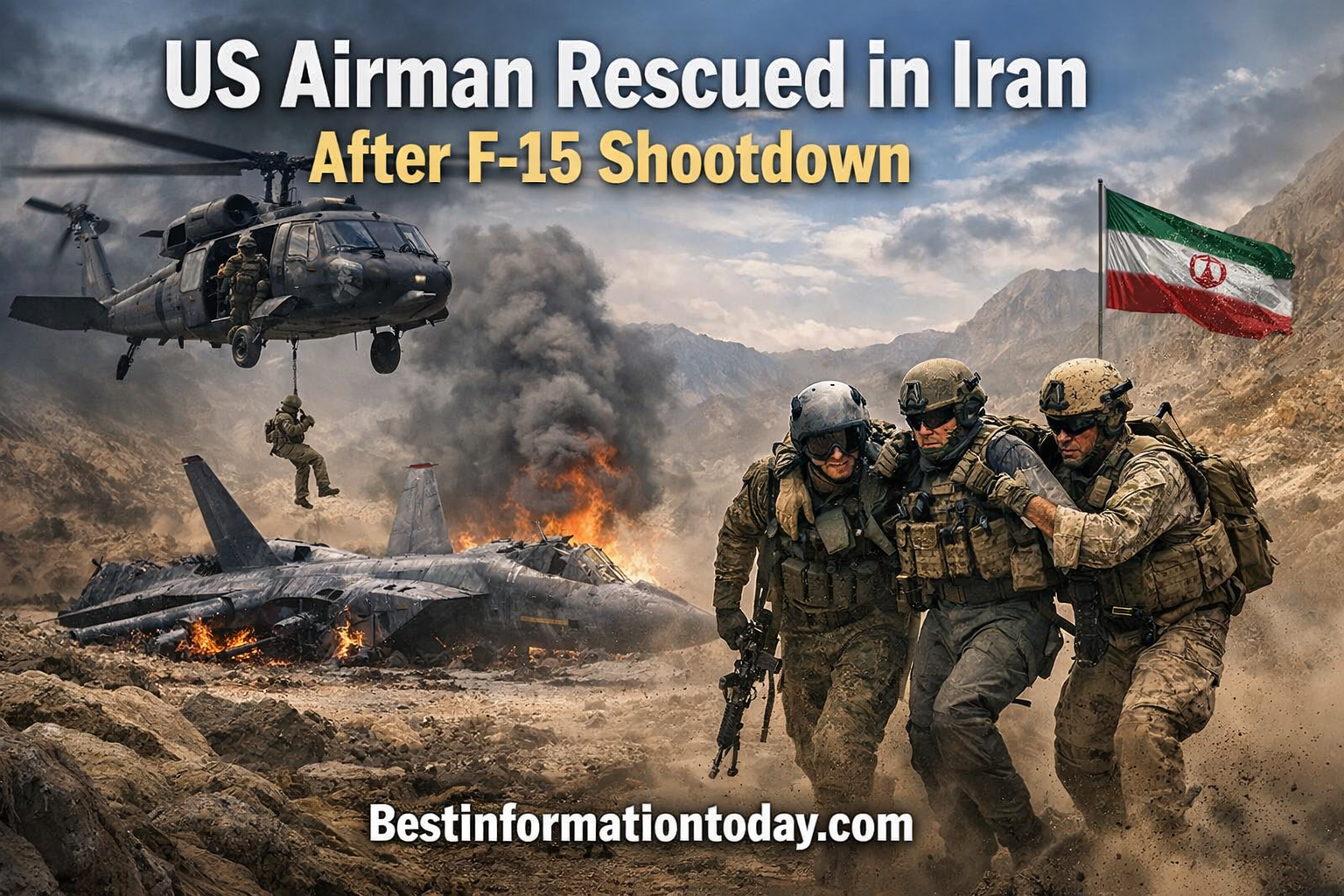
The story began on Friday when a US F-15E Strike Eagle fighter jet was shot down over southern Iran. According to US officials, the aircraft was brought down by Iranian air defense systems during active combat operations.
Iranian authorities claimed responsibility, stating that their air defense network successfully targeted the aircraft—possibly using advanced or newly deployed missile systems.
The F-15E is a two-seat aircraft, meaning both a pilot and a weapons systems officer were onboard at the time of the incident. After the jet was hit, both crew members managed to eject safely, landing in hostile territory.
This marked a major escalation in the ongoing conflict and represented one of the first confirmed instances of a US crewed aircraft being downed inside Iran during the current war.
Immediate Aftermath: A Race Against Time
Following the shootdown, the situation quickly turned into a race against time. US forces launched a search-and-rescue mission almost immediately, aiming to locate and recover both crew members before Iranian forces could reach them.
One of the airmen was rescued relatively quickly after ejecting. However, the second crew member remained missing, triggering an intense and high-stakes recovery effort.
Reports indicate that both airmen were able to establish communication after ejecting, which likely played a critical role in guiding rescue teams.
Meanwhile, Iranian forces—including the Islamic Revolutionary Guard Corps (IRGC)—were also mobilized to locate the missing airman. This created a dangerous scenario in which both sides were actively searching for the same individual in contested terrain.
Iranian state media even encouraged civilians to assist in locating the downed American, highlighting the urgency and intensity of the situation.
The Rescue Operation: “One of the Most Daring”
The rescue of the second crew member took place after nearly two days of searching in what officials described as extremely difficult conditions. The airman had landed in mountainous terrain and was reportedly injured but able to evade capture.
US President Donald Trump confirmed the successful rescue on Sunday, calling it “one of the most daring search and rescue operations” in US military history.
Although full operational details have not yet been disclosed, several key elements have emerged:
1. Large-Scale Military Involvement
The mission reportedly involved dozens of aircraft, including helicopters, refueling planes, and fighter jets providing air cover.
2. Special Operations Forces
Elite US special forces were deployed on the ground to locate and extract the airman from hostile territory.
3. Combat Conditions
The rescue did not occur in isolation—it unfolded under active threat. US aircraft came under Iranian ground fire, and some were damaged during the mission.
4. Deception Tactics
According to officials, US intelligence agencies carried out a deception campaign to mislead Iranian forces about the timing and location of the rescue.
5. Equipment Losses
At least one US aircraft had to be destroyed after suffering mechanical failure during the mission, underscoring the operation’s complexity.
Despite these challenges, the mission ultimately succeeded, and the airman was safely recovered.
Risks and Challenges Faced
The rescue mission was exceptionally dangerous for several reasons:
Hostile Territory
The operation took place deep inside Iran, where US forces faced the constant threat of detection and engagement by Iranian military units.
Active Enemy Search
Iranian forces were simultaneously searching for the same airman, increasing the likelihood of direct confrontation.
Difficult Terrain
The mountainous environment made navigation, communication, and extraction significantly more difficult.
Ongoing Conflict
The rescue occurred during an active war, meaning the skies and ground were already contested with ongoing military operations.
In addition, reports indicate that other US aircraft were targeted during the broader operation, including an A-10 Thunderbolt II that was hit but managed to reach safety before the pilot ejected.
Strategic and Political Implications
The successful rescue has both military and political significance.
A Tactical Success
From a military perspective, the operation demonstrates the United States’ ability to conduct complex personnel recovery missions in hostile environments. It also highlights the importance placed on recovering service members, even under extreme risk.
A Propaganda Victory
For the US government, the rescue provides a powerful narrative of success and resilience. President Trump’s public statements emphasized bravery and operational excellence, reinforcing domestic support.
A Missed Opportunity for Iran
Had Iran captured the airman, it could have used the situation as a major political and strategic advantage, potentially leveraging the individual as a bargaining chip in negotiations.
Escalation Risks
At the same time, the incident underscores the intensity of the ongoing conflict. The fact that US aircraft are being shot down and rescue missions are taking place inside Iran suggests a deepening and potentially widening war.
The Bigger Picture: A Growing Conflict
The rescue operation cannot be viewed in isolation. It is part of a broader conflict that began in late February and has already resulted in significant casualties and regional instability.
The war has:
- Involved multiple countries, including Israel
- Resulted in thousands of deaths
- Disrupted global energy markets
- Increased geopolitical tensions worldwide
The downing of the F-15 and subsequent rescue mission highlight how quickly the situation can escalate and how high the stakes have become.
What Remains Unclear
Despite the available information, several important questions remain unanswered:
- Exact rescue timeline: The precise sequence of events during the operation is still unknown.
- Location details: The exact location of the downed airman and rescue site has not been disclosed.
- Extent of damage: While some aircraft losses have been reported, the full scale of damage to US and Iranian forces is unclear.
- Iran’s response: It remains uncertain how Iran will respond to a US ground operation inside its territory.
As more information emerges, a clearer picture of the operation will likely develop.
Conclusion
The rescue of the US airman in Iran stands as a remarkable example of modern military capability, coordination, and risk-taking. Conducted under extreme pressure and in hostile territory, the mission underscores both the dangers of the მიმდინარე conflict and the lengths to which nations will go to protect their personnel.
While hailed as a success by US officials, the operation also serves as a stark reminder of the volatility of the current geopolitical landscape. With tensions still high and the conflict ongoing, this dramatic rescue may be only one chapter in a much larger and more complex story still unfolding.